
How OEM Trigger Switch Factories Drive Industrial Innovation
2026-06-02
In the relentless pursuit of industrial advancement, the unsung heroes often reside within the supply chain—none more pivotal than OEM trigger switch factories. These specialized manufacturers don't just produce components; they shape the reliability and intelligence of everything from power tools to smart appliances. At the forefront of this quiet revolution is KEJIAN ELECTRONICS, a factory that redefines partnership by blending precision engineering with agile innovation. Discover how such deep-domain expertise turns custom switch designs into catalysts for smarter, safer industrial ecosystems—and why your next breakthrough might hinge on the trigger beneath your finger.
Beyond Standard Parts: Custom Switch Designs That Redefine Machinery
Standard switches often fall short when machinery demands more. Off-the-shelf components come with fixed dimensions, limited mounting options, and generic actuation profiles that rarely match the exact needs of specialized equipment. By working directly with manufacturers to create tailored switch designs, engineers gain complete control over every aspect—from the tactile response and electrical rating to the materials that withstand harsh chemicals or extreme temperatures. This level of customization erases the compromises that typically haunt machine builders, allowing them to integrate switches seamlessly into the overall vision rather than designing around what's readily available.
Beyond mere functionality, custom-designed switches can redefine a machine's identity. A unique interface that responds to the lightest touch or a rugged control panel that survives washdown environments without failure—these details elevate equipment from ordinary to memorable. When switch design aligns perfectly with the machine's purpose, operators experience less fatigue, maintenance becomes simpler, and the entire system feels more cohesive. The result isn't just a component; it's a deliberate choice that sets machinery apart in a crowded field.
Smart Trigger Switches: Embedding Intelligence into Industrial Controls
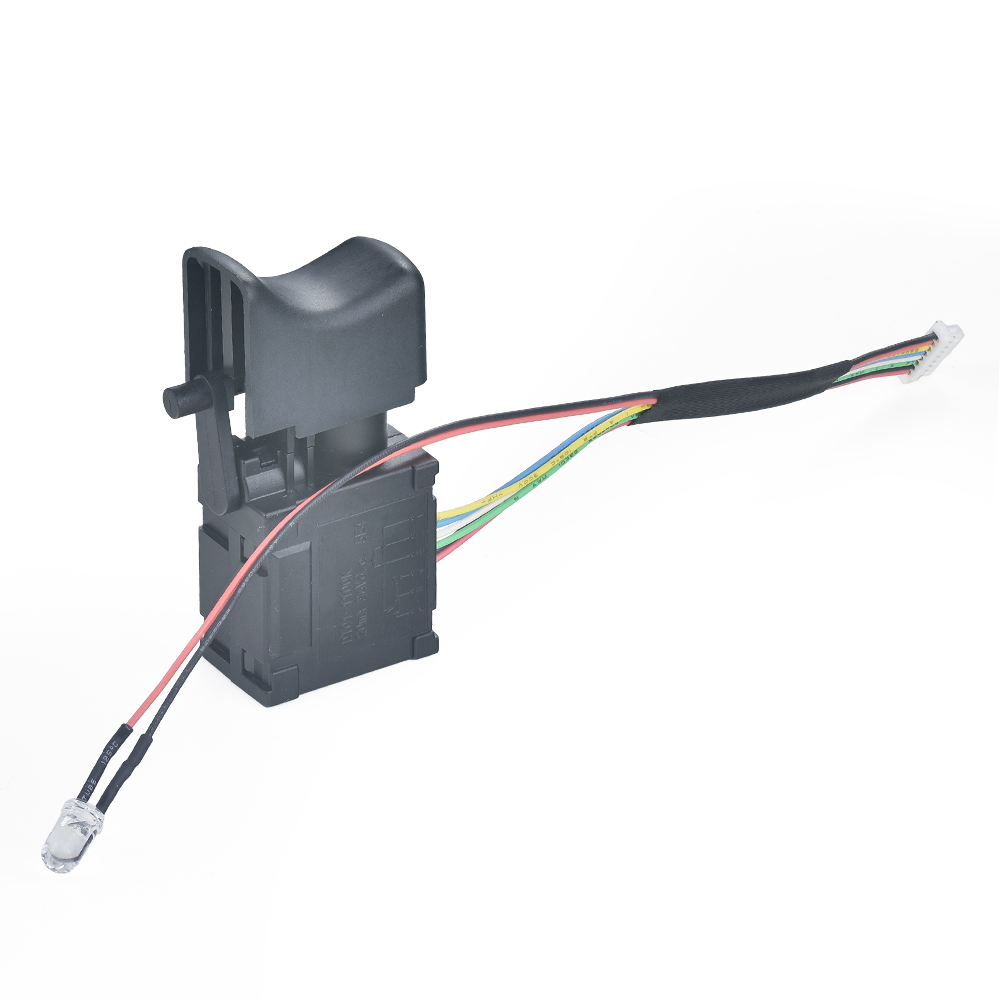
Traditional trigger switches in industrial machinery operate on a simple on/off logic, reacting to physical force without any awareness of context. Embedding intelligence transforms these components into decision-making nodes. Modern smart trigger switches pack microcontrollers, sensors, and connectivity right into the assembly, allowing them to interpret pressure patterns, adapt to operator habits, and flag anomalies before they lead to downtime. Instead of just closing a circuit, they become active participants in the control loop, learning from each actuation to refine machine responses.
The real value surfaces in harsh manufacturing environments where conditions shift constantly. Imagine a stamping press that feels the gradual degradation of a die through the trigger’s feedback—adjusting force in real time or alerting maintenance without human intervention. These switches can run local diagnostics, store usage logs, and communicate over industrial protocols like IO-Link. This embedded intelligence cuts through false triggers, compensates for mechanical wear, and turns a mundane component into a rich data source for digital twins and predictive models.
Adoption follows a clear payoff: reduced unplanned stops and safer operation. In automotive assembly, smart triggers help robots handle fragile parts by modulating grip based on tactile feedback, slashing scrap rates. In packaging lines, they distinguish between product jams and normal variations, preventing unnecessary line halts. As factories migrate toward autonomous systems, such switches blur the line between control and cognition—no longer just endpoints, but edge devices that shape the process they’re part of.
From Concept to Production: How Agile Manufacturing Accelerates Innovation
Shifting from a rigid, linear development model to agile manufacturing transforms how ideas become physical products. Instead of waiting weeks for tooling or production line adjustments, teams can iterate on prototypes within days. This rapid feedback loop means that a design flaw found on Tuesday can be corrected and tested by Thursday, drastically compressing the concept-to-production timeline. It's not just about speed—it's about keeping the creative momentum alive, allowing engineers and designers to refine a product without losing the original spark of the idea.
Agile manufacturing blurs the line between conceptual work and production reality. When the same modular systems can quickly switch from assembling prototype components to running a pilot batch, the traditional hand-off phase disappears. There’s no need to “translate” a concept for production engineers because the team is already working in a production-ready environment. This alignment reduces misinterpretation and ensures that the final output closely reflects the intended design, while also surfacing production constraints early enough to influence the concept itself.
Perhaps the most significant impact is on risk reduction. In traditional settings, committing to a full production run before thoroughly testing a concept could lead to costly waste if a flaw was discovered later. Agile manufacturing allows for small, cost-effective pilot runs that validate both the design and the manufacturing process simultaneously. It turns innovation into a series of manageable, real-world experiments, where each iteration builds practical insight. The result is a faster path to a robust, market-ready product, without the anxiety of large, irreversible investments.
Material Science Meets Trigger Switches: Pushing Durability and Sensitivity Limits
The convergence of advanced material science and trigger switch engineering is reshaping what these components can endure and how they respond. By integrating novel alloys and nano-structured coatings, manufacturers are drastically reducing mechanical wear, allowing switches to withstand tens of millions of cycles without degradation. These materials not only resist abrasion but also maintain consistent electrical contact under extreme thermal and vibrational stress, extending service life far beyond traditional designs.
Meanwhile, sensitivity is being redefined through the use of responsive composites that amplify minute physical inputs. Smart polymers and piezoelectric fibers embedded within the switch structure detect subtle pressure changes, translating them into crisp, instant actuation with minimal hysteresis. This enables triggers to deliver both feather-light touch for precision tasks and robust feedback for high-force applications, adapting dynamically to user intent.
The marriage of durability and sensitivity hinges on overcoming traditional trade-offs, where tougher materials often dulled responsiveness. By leveraging multi-layered surface treatments and self-healing elastomers, engineers are creating switches that maintain factory-fresh performance after years of heavy use. The result is a new generation of triggers that feel alive under the finger, blending resilience with exquisite tactile refinement in ways previously thought impossible.
Cross-Industry Pollination: Trigger Switch Innovations Spawned by Diverse Demands
Trigger switches might seem like humble components, but their evolution tells a story of unlikely collaborations. In automotive manufacturing, the need for switches that withstand extreme vibration and temperature swings pushed engineers toward rugged, sealed designs. Meanwhile, medical device makers demanded ultra-compact, sterilizable switches with precise actuation forces. Gaming hardware, on the other hand, chased lightning-fast response and satisfying tactile feedback. Instead of solving these challenges in isolation, designers began borrowing ideas across sectors—automotive durability met medical precision in a new wave of hybrid switches, while the soft-touch mechanisms from consumer electronics found their way into industrial controls. This cross-pollination turned the trigger switch from a simple on-off device into a highly specialized component shaped by diverse, and often conflicting, real-world demands.
A prime example is the migration of Hall effect sensors from car pedals to game controllers. Originally developed for throttle-by-wire systems that must endure years of grit and grime, these contactless magnetic sensors now give gamers drift-proof analog triggers with buttery smooth gradations. Similarly, the micro-sealed reed switches perfected for harsh medical environments have been repurposed in offshore equipment and smart agriculture sensors, where moisture and corrosion are constant threats. Even the crisp snap of a mechanical keyboard switch owes a debt to industrial switchgear that prioritized clear actuation points for safety. By melding insights from unrelated fields, trigger switch design has become a collaborative art—one where a breakthrough in a hospital device might quietly reshape the feel of a game controller, or a heavy-machinery innovation ends up in a wearable gadget. The result is a continuous loop of refinement that keeps these humble switches at the heart of modern technology.
The Next Frontier: How Trigger Switch Factories Are Shaping Tomorrow's Factories
Most people never stop to think about the humble trigger switch—the tiny component that brings power tools, medical devices, and industrial equipment to life. But in the factories where these switches are built, a quiet transformation is underway. The precision required to produce a switch that can endure millions of cycles without failing demands an almost obsessive attention to material science and micro-assembly. Conductive alloys are tweaked to resist arc erosion, contact points are ultrasonically welded under microscopic vision, and every batch undergoes rapid-cycle testing that simulates decades of hard use in a matter of hours. It’s a world where a five-micron deviation can mean the difference between flawless operation and a warranty claim, pushing manufacturers to blend old-world craftsmanship with algorithmic process control.
What’s less obvious is how these specialized production lines are spilling over into the broader manufacturing landscape. The same adaptive robotics that insert tiny springs into molded housings are now being reconfigured for electronics assembly and automotive sensor placement. Machine learning models trained to spot microscopic cracks in switch housings are finding second lives in quality inspection for injection-molded packaging. By solving the extreme challenges of trigger switch production—miniaturization, reliability, cost containment—these factories are essentially road-testing the methods that will become standard in everything from aerospace component fabrication to consumer gadget assembly. Tomorrow’s factories won’t all make trigger switches, but many of their guiding principles will have been forged in the crucible of getting a simple click to feel just right, every single time.
FAQ
OEM trigger switches serve as critical control interfaces, translating physical input into precise digital commands that keep automated systems responsive and safe. They often integrate with advanced control circuits, enabling real-time adjustments and fault detection on production lines.
By collaborating early with OEM switch manufacturers, machine builders can embed tailored tactile feedback, force profiles, and communication protocols directly into the design. This eliminates the need for later-stage retrofits and compresses product launch timelines by weeks or even months.
Custom switches can incorporate redundant contacts, emergency-stop logic, and sealed housings that resist dust, moisture, and chemicals. Some models feature capacitive touch backup or light-touch actuation that reduces repetitive strain injuries, lowering incident rates in foundries, mills, and cleanrooms.
Absolutely. Many now use in-house 3D printing for ergonomic mockups and accelerated life-cycle test rigs that simulate millions of cycles. This parallel engineering approach lets them deliver proven, application-tested prototypes in days, not weeks, while meeting IP ratings and shock/vibration standards.
OEMs are developing low-current switching mechanisms and sleep-mode electronics that minimize power draw when equipment idles. Some integrate energy-harvesting modules that capture kinetic energy from the trigger pull itself, powering wireless transmitters and eliminating disposable batteries in remote industrial tools.
Buyers now prioritize switches that provide digital twin compatibility, onboard diagnostics, and Ethernet/IP or IO-Link connectivity. Factories that embed predictive maintenance data into the switch’s output streamline integration with MES and ERP systems, making them preferred partners for smart-factory rollouts.
Off-the-shelf solutions often lead to inflated inventories, frequent recalibrations, and unexpected downtime from premature wear. A knowledgeable supplier conducts application analysis that identifies the optimal materials, contact geometries, and mounting options upfront, slashing total cost of ownership by reducing warranty claims and line stoppages.
We’re seeing hall-effect sensing replace mechanical contacts for longer life, augmented reality overlaid on the switch for step-by-step operator guidance, and bio-based polymers used in housings to meet circular-economy targets. Miniaturized multi-axis switches are also emerging for collaborative robots that demand intuitive yet robust human-robot interaction.
Conclusion
OEM trigger switch factories are moving decisively beyond catalog parts, crafting custom designs that reshape machinery ergonomics and functionality. By adapting actuation force, form, and tactile feedback to specific equipment, they give new capabilities to everything from handheld tools to automated assembly lines. At the same time, smart trigger switches are embedding intelligence where it matters most—sensors and haptic feedback systems integrate directly into the trigger, enabling adaptive control that responds to grip pressure, motion, and operating conditions. Agile manufacturing methods turn these concepts into robust, production‑ready units in record time, compressing the innovation cycle and letting machine builders iterate fearlessly.
Advances in material science are equally decisive, with new polymers and composites stretching durability and sensitivity limits so switches survive extreme vibration, chemicals, and millions of cycles without losing precise tactile response. Cross‑industry demands act as an innovation accelerator: a lightweight medical trigger evolves into a rugged construction variant, while a waterproof marine design inspires improvements in food‑processing equipment. This cross‑pollination creates a constantly expanding design library. Looking forward, trigger switch factories are no longer component suppliers—they are core partners engineering the future factory floor, where intelligent, ultra‑reliable triggers become seamless nodes in autonomous, interconnected systems that learn, adapt, and communicate.
Contact Us
Contact Person: Anna lin
Email: [email protected]
Tel/WhatsApp: +86 13567768885
Website: https://www.kjele.com/